

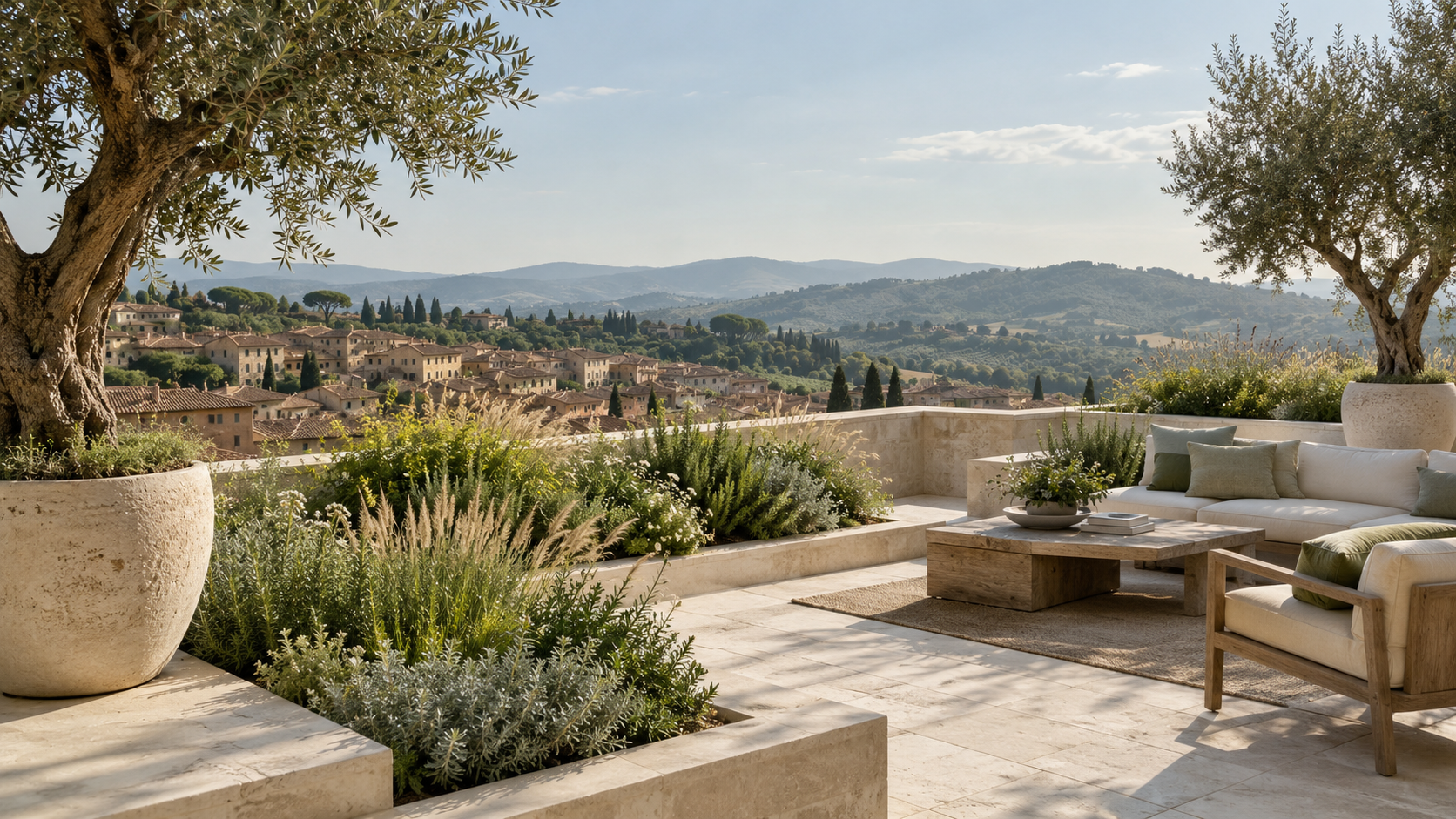
Choose the activity that matters most
A terrace can accommodate many different moments, but trying to include all of them at once often makes the space feel confused. Before choosing furniture or planters, identify the activity you most want to encourage. Dinner with friends, a quiet afternoon or breakfast every morning each suggests a different arrangement. Giving one activity priority does not exclude the others; it provides a useful order.
Picture the terrace when nobody is using it as well. The table still occupies space, chairs still create volume and planters still form the view from indoors. A convincing composition should work both when you are in it and when you see it through the window.
Plan the open space first
Open space is not simply what remains after everything else has been arranged. It is where you walk, open a door, pull out a chair and put down a tray. Marking these movements on even a simple plan reveals the real footprint of furniture. A dining table occupies more than its top: people need room to sit and others need room to pass.
Try marking possible positions on the terrace with temporary guides, then walk through as you would on an ordinary day. This makes awkward points apparent in a way that a catalogue photograph cannot. Keeping a clear route is often the decision that makes an outdoor space feel more generous.
Give planters a coherent scale
A long row of small pots can break a terrace into fragments. Working with groups and a limited family of shapes helps establish rhythm. The container is part of the design as much as the plant it holds: its height, texture, colour and position all affect how the edge of the space is perceived.
There is no ideal size that suits every setting. Choices need to consider the available space, the needs of the planting and the characteristics of the terrace, with relevant checks by the professionals involved. Visually, it is also worth looking at containers from inside the house. A rim should not interrupt an important view without a clear reason.
Use planting to create depth
A terrace begins to feel like a garden when plants relate to one another instead of appearing as separate objects. Different leaf sizes, recessed groups and a few taller forms can create a foreground and a background. Overlapping layers add depth too: the whole composition does not need to reveal itself from every position at once.
Start with a simple structure and let the planting bring variation. Repeating a shape can connect opposite ends of the terrace, while a softer group might frame a seat. Choose individual plants after observing light, wind and growing conditions, so the atmosphere you want remains connected to the place you actually have.
Put shade and screening where they help
Wanting shade does not necessarily mean covering the entire terrace. The important questions are where and when you need it. Follow the light during the hours you expect to spend outside, then relate the shaded area to the main table or seating. A canopy can look beautiful from a distance yet do little for the activity beneath it.
Screening benefits from the same precision. Identify the particular sightlines you want to soften and consider a local response that preserves openness elsewhere. Planting, a screen and a different furniture arrangement can work together. Remember to assess the view while seated: that is often the position in which you will spend the most time.
Connect materials with the evening atmosphere
The terrace can relate to the interior through a family of tones without repeating every finish. Pale stone might find an echo in a natural fabric; a dark frame can give definition to softer surfaces. Keep the main palette considered and look at samples outside, where daylight changes the way colour and texture appear.
For the evening, begin with actions: reaching the door, following a route, sitting down to eat. Lighting everything equally can flatten a space. Carefully placed light helps distinguish areas while allowing some shadows to remain. Atmosphere comes from the relationship between illuminated and quieter parts, together with the surfaces that receive the light.
Make room for ordinary change
Before calling the arrangement complete, ask what could be removed. An unnecessary repetition, a rarely used chair or too many competing fabric colours can weaken an otherwise clear composition. Simplicity does not require an empty terrace. It means that each element has a role, whether practical or visual, that is easy to recognise.
Finally, consider how you will reach the plants, where everyday objects will go and which pieces might move as the seasons change. A terrace becomes part of the house when it is easy to inhabit. The aim is not a scene that must stay perfectly untouched, but an outdoor room that welcomes small adjustments and different kinds of day.