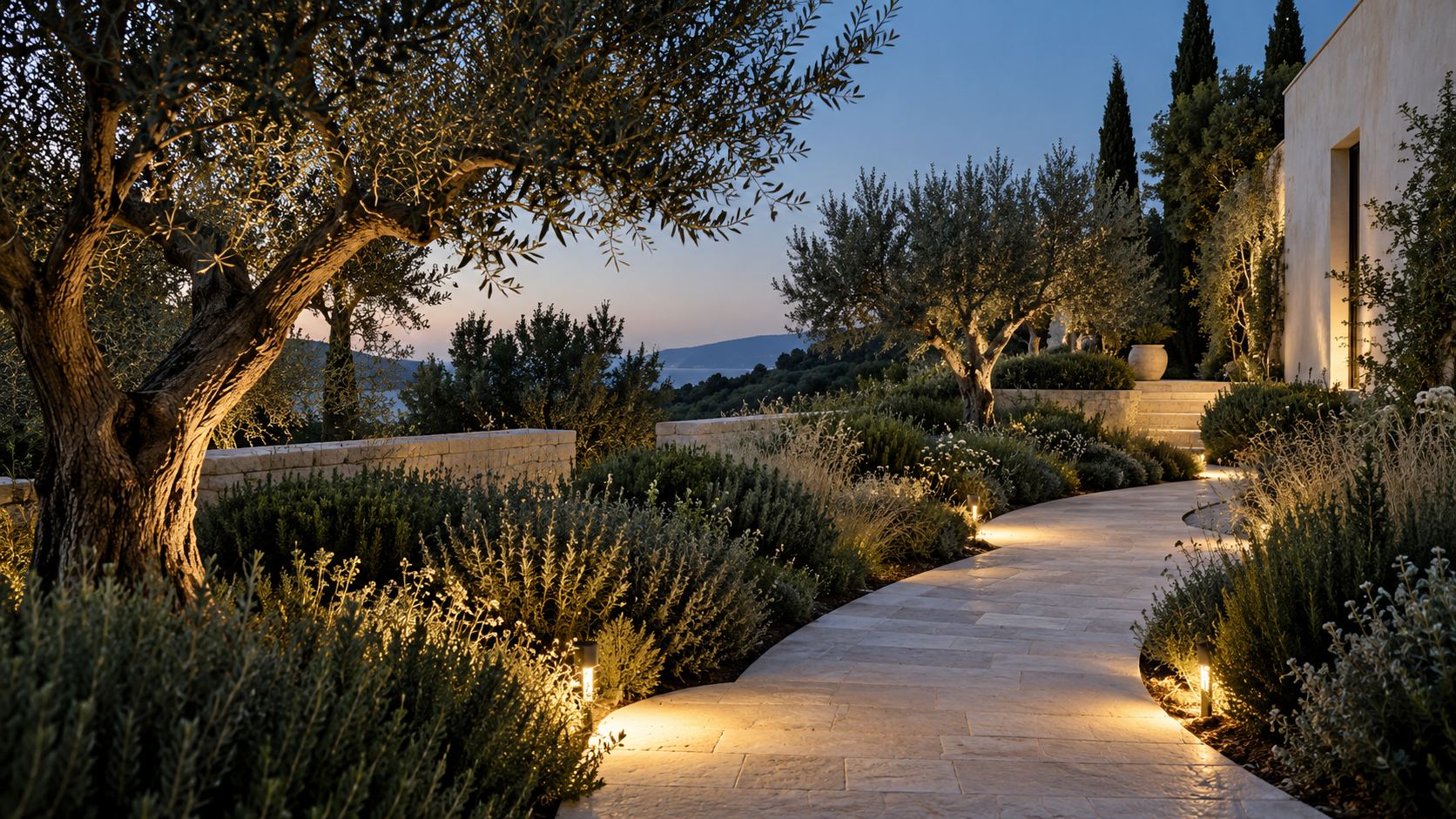
Shaping the evening with restraint
The garden after dark does not need to reproduce its daytime appearance. We identify what should remain readable and what can stay in shadow: an entrance, a change of direction, the presence of a tree or the edge of a seating area. The lighting concept establishes a hierarchy among these elements. A few carefully chosen points can clarify the space without flattening its depth or competing with the atmosphere of the house.
The relationship between fittings, surfaces and vegetation is also considered in daylight. Position and character should find a place within the design, while technical selection, specification and installation are developed by the appropriate professionals. This allows the lighting to belong to the setting in both its active and inactive states.
Water and planting within one proposal
The organisation of irrigation starts with an understanding of plants and place. Different exposures, planting in soil or containers, and distinct vegetation groups may call for different approaches. The landscape design should make these needs understandable so that the technical system can be developed from shared information. Access for checking and maintenance is considered alongside surfaces, planted areas and routes.
In an existing garden, we gather available information about current systems and the matters that need further assessment. A complete replacement is not always the only possibility: a proposal may involve adapting elements to suit the new composition. The intention is to connect what is visible with what supports the space, avoiding isolated decisions that become difficult to integrate later. Each specialist contribution can then be developed in relation to a clear and consistent landscape direction.